About OsEAN
The Osteopathic European Academic Network (OsEAN) is an organisation working with a mission for better osteopathic education and bring it to a higher level.

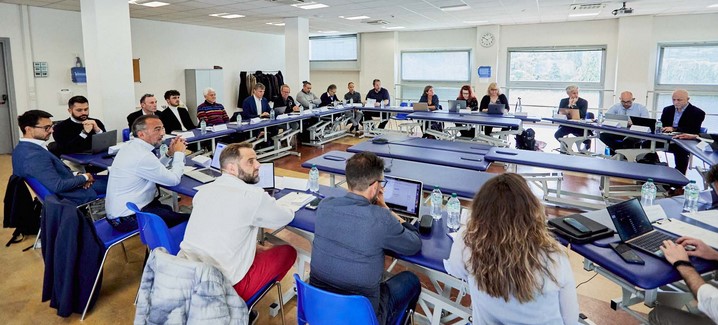
Its members share this common mission, exchange values and collaborate with vision for the future.
During the past decade Osteopathy in Europe has been expanding at an enormous speed. While it has been legally recognized in a few countries, the standards for training and practice are still different throughout Europe.
Our Mission
Our Mission is to contribute significantly to the enhancement of the quality of European osteopathic care, and to act as a major driving force for the development of osteopathy as a recognized and regulated primary healthcare profession with high standards of education, training and practice throughout Europe for the benefit of patients. We work together:
- To foster collaboration and innovation among our member schools in various areas including administration, education, research and service.
- To provide a common European representation of schools in a time of emerging European standards
- To establish and develop common research streams
- To achieve academic recognition for osteopathy in all countries
- To develop a standardised model of osteopathic education throughout Europe
- To develop active scientific, academic and professional communication links – essential for the development of osteopathy, both as an independent, clearly identifiable profession, and in its relationship with other professions in the health care sector
- To establish high academic teaching standards by making sure that osteopathic lecturers are trained in education.
Our Vision for the future
Our Vision for the future is that patients and the public are confident they will receive high standards of osteopathic care no matter where they seek treatment in Europe.
OsEAN’s objectives are to promote cooperation in Osteopathic Education and to develop a common core curriculum for part-time and full-time schools throughout Europe.
All OsEAN schools hold the tenet that Osteopathic Training should be degree validated programme at an MSc level as a precursor to the attainment of admission to practice-life. Therefore all schools strive for an academic partnership with a university to obtain that goal. Currently the OsEAN members do have such partnerships with 13 different universities, some more are in the stage of preparation.
Now legally based in Vienna, Austria as a non-profit organization, the idea of OsEAN was conceived in 2000 by Renzo Molinari, DO, the former Principal of the European School of Osteopathy/U.K.
Become a member
The organisation had been incorporated in 2008, since than it has being growing steadily and now has 28 member schools in Europe and overseas and more schools are awaiting approval to join.
If you would also like to become a member of the Osteopathic European Academic Network, you will find more information how you can do this.
Osteopathic Educational Standards
The CEN standard: EN16686 Osteopathic Healthcare Provision is setting new parameters for the osteopathic education in Europe. These standards have only just been agreed upon and will be effective from 2016.
OsEAN contributed to the development of the CEN Standard and will use it as a minimum requirement for full OsEAN memberships. OsEAN partnered up with the Austrian Standard Institute and developed a certification that applies the CEN Standard as well as the OsEAN Standard.
OsEAN's vision of Osteopathic Education
OsEAN recognizes the existing standard that is proposed by the WHO Guidelines on basic training and safety in Osteopathy.
This document presents just a minimum standard, however.
OsEAN pursues a standard of excellence as it is adequate for Osteopathy as a high quality, primary contact profession.
The OsEAN schools strive for an academic cooperation with Universities to assure the highest possible quality in Osteopathic Education. The level of a Masters degree is regarded as the academic equivalent of this pursued level of excellence.
In defining educational programs it is preferable to focus on outcomes, as encouraged by the Framework for Qualifications of the European Higher Education Area, however it is also useful to indicate what might be a suitable duration for an osteopaths’ program:
Full time training
This type of training is offered for people with no prior medical training. Entrance criteria will typically be A-level (UK), Bac Science (FR), Abitur (DE) or equivalent.
Typically five years of full time studies (an equivalent of 300 ECTS points) should lead to a Masters degree in osteopathy.
Conversion courses for people from other health professions
As an alternative to full time training, conversion courses for people from other health professions can be offered, typically for physicians or physiotherapists. Based on their prior medical training, students of these conversion courses should reach the same level of excellence and the same academic degree as graduates from full time courses.
Five years is regarded as a suitable minimum duration for this type of program.
The model above represents OsEAN’s vision for the future of Osteopathic Education in Europe, recognizing that the member schools do not fulfill the criteria yet at the present moment.